
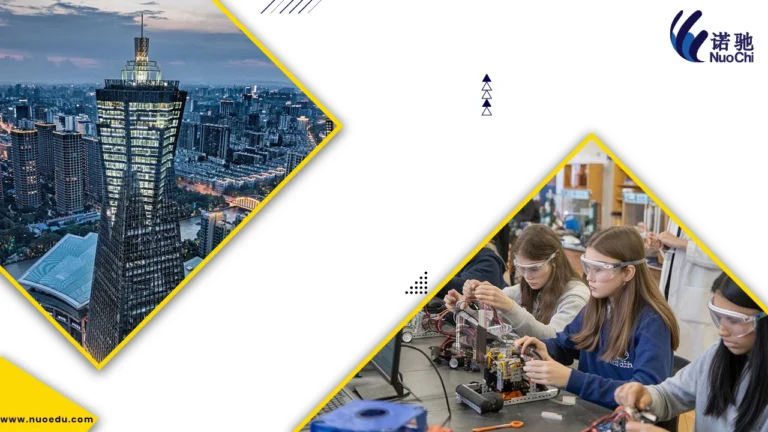
STEM education has become the cornerstone of national economic agendas worldwide. China has become a top-rated country when it comes to promoting innovation and STEM learning in South Asia. Globally, China’s impact is massive for promoting science and technology education of a quality similar to that provided by the United States and the UK.
If you are an international student seeking quality and affordable STEM education options in South Asia instead of the expensive US or Canada, China offers you the best study option for building a rewarding future.
In this post, you will understand why China provides international students a compelling combination of affordability, cutting-edge research, and unique cultural immersion through world-class STEM education. You will understand why studying STEM in China, compared to other Western countries, can set you apart as an industry leader in the world.
China’s STEM Programs: The Cost Advantage Changes the Game
Perhaps the most striking difference when comparing STEM programs is affordability. In the United States or Europe, you may have to pay much higher tuition fees for studying top-notch STEM courses compared to China. The country demands a significantly lower cost of education compared to top-ranking UK and US universities. China’s STEM programs will cost you a fraction of what you’d pay at MIT, Stanford, or Imperial College London.
The financial appeal extends beyond tuition. Living expenses in Chinese cities. For instance, the two most populated and expensive cities in China are Beijing and Shanghai. These cities have a massive student population from Pakistan and other countries worldwide. However, living in these cities is also a lot cheaper than living in the UK’s capital, London, or New York, United States
This implies that by paying significantly less than in the world’s largest countries, you can enjoy affordable housing, food, and public transportation in China. Indeed, China will become one of the most budget-friendly destinations for STEM education in 2027.
Besides, it is much easier to get a scholarship in China compared to at the United States’ top universities. The government itself supports international students and offers generous funding opportunities. You can easily pay for your:
- Tuition fee in China
- Accommodation expenses and bills
- And even get a handsome monthly living allowance.
This level of financial support is considerably higher than what Western countries typically provide, making STEM education in China accessible to students who might otherwise be priced out.
Research and Innovation: This is Where China Offers an Edge
China’s rise in STEM is not just about cost; it’s backed by serious research muscle. China placed ahead of Switzerland, Singapore, and Denmark with 85.46 points, only behind the United States at 86.50 on the first Global STEM Education Development Index 2025. Developed by Tongji University STEM Education think tank, the index assessed 40 nations across 22 indicators; China’s performance was notably strong in terms of educational processes, teacher competency, student achievement, and graduate output.
Actually, China exceeds the US in several STEM raw excellence metrics. A relative analysis reveals China’s supremacy in postgraduate and undergraduate STEM percentages, number of doctoral graduates, and STEM publications; it scores 100 in all these metrics, while the US has lower ratings.
China boasts top-notch research infrastructure throughout the globe. Many institutions work with those like MIT and Oxford to provide students access to cutting-edge resources and worldwide research networks. Made in China 2025 and other government-backed programmes added 1,673 industry-related undergraduate programmes in 2024 alone, hence supporting a strategic alignment between education and corporate demand.
Cultural Experience: More Than Just Academics
What makes China uniquely valuable is the cultural dimension. STEM students in China gain exposure to one of the world’s oldest civilizations while witnessing rapid technological transformation firsthand.
One of the most widely spoken languages in the world, and learning Mandarin helps one to find chances in the developing economies of Asia. Though they too provide cultural variety, Western nations present something else: immersion in a society effectively fusing modern technology with traditional customs.
-
China vs. The US
The United States remains the global leader in STEM education, largely due to its established institutional resources and funding advantages.
Emphasizing creativity, business startup culture, and commercialization, US universities encourage students to bring their studies to market. This, nevertheless, comes at a great expense with costly living costs and excessive tuition comes at a great cost.
With large investments in strategic industries like artificial intelligence, renewable energy, and quantum computing, China’s strategy is more government-driven. Though the US is multiculturally varied, China provides intense immersion in a society that sees technological advancement in a totally different way. Your decision is based on your preference of China’s state-backed research infrastructure or the Silicon Valley startup scene.
-
China vs. The UK
British STEM programs are renowned for their quality mentorship and applied research. Universities like Imperial College London and Cambridge are globally recognized for translating academic knowledge into practice. But again, cost is a major barrier, the UK tuition and living expenses are prohibitively high for many international students.
China matches the UK’s academic intensity at a fraction of the cost. China’s emphasis on collaboration gives students access to advanced international research without the financial burden. For budget-conscious students seeking quality education, China has become an attractive alternative.
-
China vs. Europe
Particularly in nations like Germany and the Netherlands, Europe provides robust STEM courses emphasizing theoretical approaches and sustainability. For EU students, tuition is usually reasonable; for foreign students, it is higher, and lodging in big European cities is costly.
Together with smart investments in artificial intelligence and renewable energy, China’s enormous physical and digital infrastructure positions it as a viable choice. Low tuition costs and research possibilities help China stand out
-
China vs. Australia
China shows better scale and output in STEM; it leads in the percentage of doctoral, postgraduate, and undergraduate graduates as well as the number of STEM publications. Trends in research show that Chinese STEM research concentrates on K–12 teaching and learning as well as policy and curriculum creation. Australia’s STEM study shows a clear emphasis on the link between education and business. Studies show that formal science instruction starts later in China, grade 3, than in Australia, kindergarten, culturally. Though high socioeconomic background pupils do fairly well, Australian early exposure could give those from underprivileged backgrounds an edge.
5. China vs. Canada
With its Canada 2067 initiative pushing an inclusive K–12 STEM approach meant for structural equity, Canada stresses broad participation. Reflecting a federal system, Canada’s STEM education is decentralized. China’s strategy is more centrally focused and strategically relevant to national objectives. Research reveals Canada tops in a study on social problems, gender, and culture in STEM and gives more focus on postsecondary STEM instruction. In contrast, China stresses that K–12 subjects have significantly higher STEM graduate and research publication output.
The Future of STEM Education in China
China’s STEM education is changing quickly, not only keeping up with the times, but also Making AI education a national priority, the country has increased the number of institutions providing AI-related courses from only 35 in 2018 to more than 600 now. STEM programs such as the STEM Education 2035 Action Plan are further enhancing international cooperation and talent development.
Universities like the University of Science and Technology of China (USTC), Tsinghua University, and Westlake University are vigorously seeking foreign students, providing English-taught courses, cutting-edge research facilities, and attractive scholarships.
Making the Choice
China stands out among STEM programs around the world for its distinctive value proposition: top-notch education at reasonable prices, cutting-edge research possibilities geared to national objectives, and cultural immersion that enhances world knowledge. China should be given significant thought, whether you are looking for affordable tuition, participation in major research initiatives, or exposure to a quickly developing economy.
For students considering Europe, the United States, or the United Kingdom, China’s mix of legacy and scientific advancement makes it an increasingly appealing choice for STEM education. China is positioning itself as a leader rather than merely a competitor as the world STEM scene changes, and for overseas students, this provides a possibility worth looking into.